Espressif’s ESP32-S31 is narrowing the practical gap between a microcontroller and a small Linux computer by combining two fast RISC-V cores with virtual-memory features, wired networking and a broad set of device interfaces. The chip can run Linux with a more conventional architecture than earlier experimental ESP32 ports, but its memory limits remain a major dividing line.
The processor has two 32-bit RISC-V cores running at up to 320 MHz, plus a separate 40 MHz low-power core. Crucially for Linux, its main cores support Sv32 two-level page-table translation and Machine, Supervisor and User privilege modes. Those features let a kernel run in supervisor mode above lower-level firmware, instead of relying on the more constrained memory-mapping blocks found in previous ESP32 products.
Espressif has already published a Linux board-support package built around Buildroot and U-Boot. It includes a kernel, device tree and root filesystem, although the company says the software is not yet recommended for production. Community work has also produced ports with working hardware drivers and a console displayed on an 800-by-480 panel.
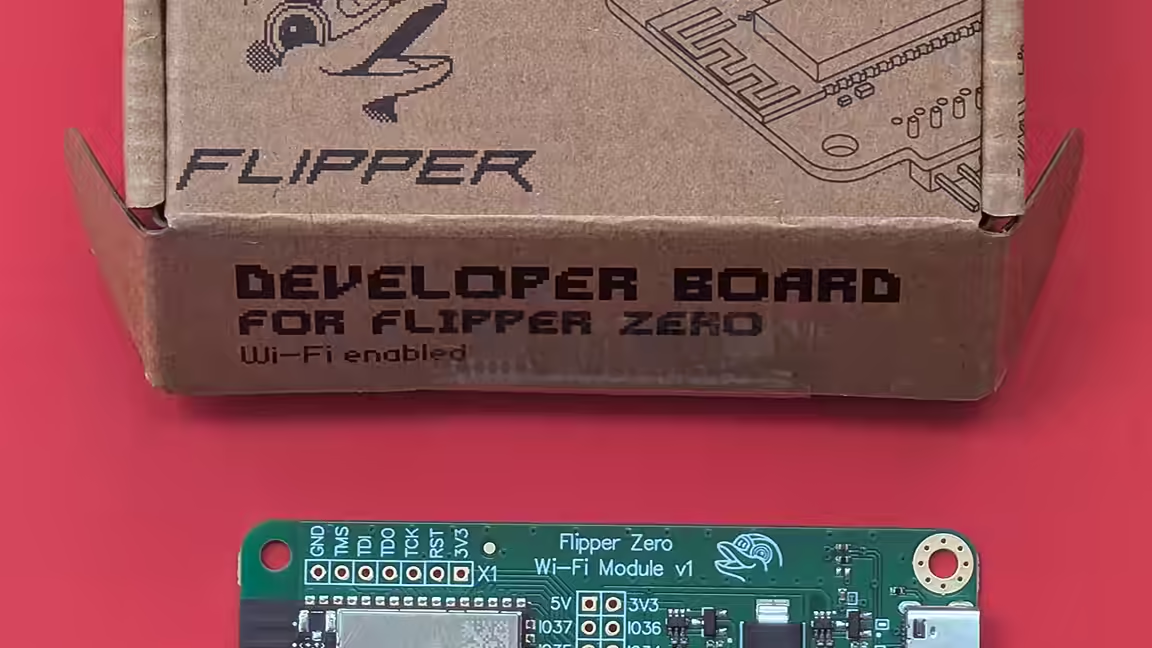
Connectivity is another substantial change. The ESP32-S31 includes a gigabit Ethernet MAC using an RGMII connection to an external physical-layer chip. Its official development board also provides a USB 2.0 High-Speed host controller with a full-size Type-A port. Two SDIO slots, a parallel camera input and a display controller give developers direct routes to storage, imaging and screens.
The peripheral list extends to two I2S audio controllers, capacitive-touch channels, CAN FD and motor-control hardware. Wireless support covers 2.4 GHz Wi-Fi 6, Bluetooth 5.4—including both Low Energy and Classic modes—and an 802.15.4 radio for Thread and Zigbee. That combination could suit connected control panels, gateways and embedded devices that need several radio standards without separate modules.
Despite those computer-like capabilities, the S31 remains constrained compared with a typical Raspberry Pi-class board. It has 512 KB of on-chip SRAM, with variants carrying 16 MB or 32 MB of in-package PSRAM and support for as much as 64 MB. It has no DRAM controller, GPU or neural-processing unit. Linux builds therefore execute the kernel from flash to conserve scarce working memory, and a full graphical desktop is not the intended workload.
The gigabit label also describes the Ethernet interface rather than a promise that every application will sustain line-rate traffic. At 320 MHz, packet processing and PSRAM bandwidth may restrict performance, particularly with large numbers of small packets.
As of the event date, September 24, 2026, the ESP32-S31 is best viewed as an unusually capable embedded controller with credible native Linux support. It gives developers computer-like software isolation and peripherals while retaining the memory footprint and power profile of a microcontroller.