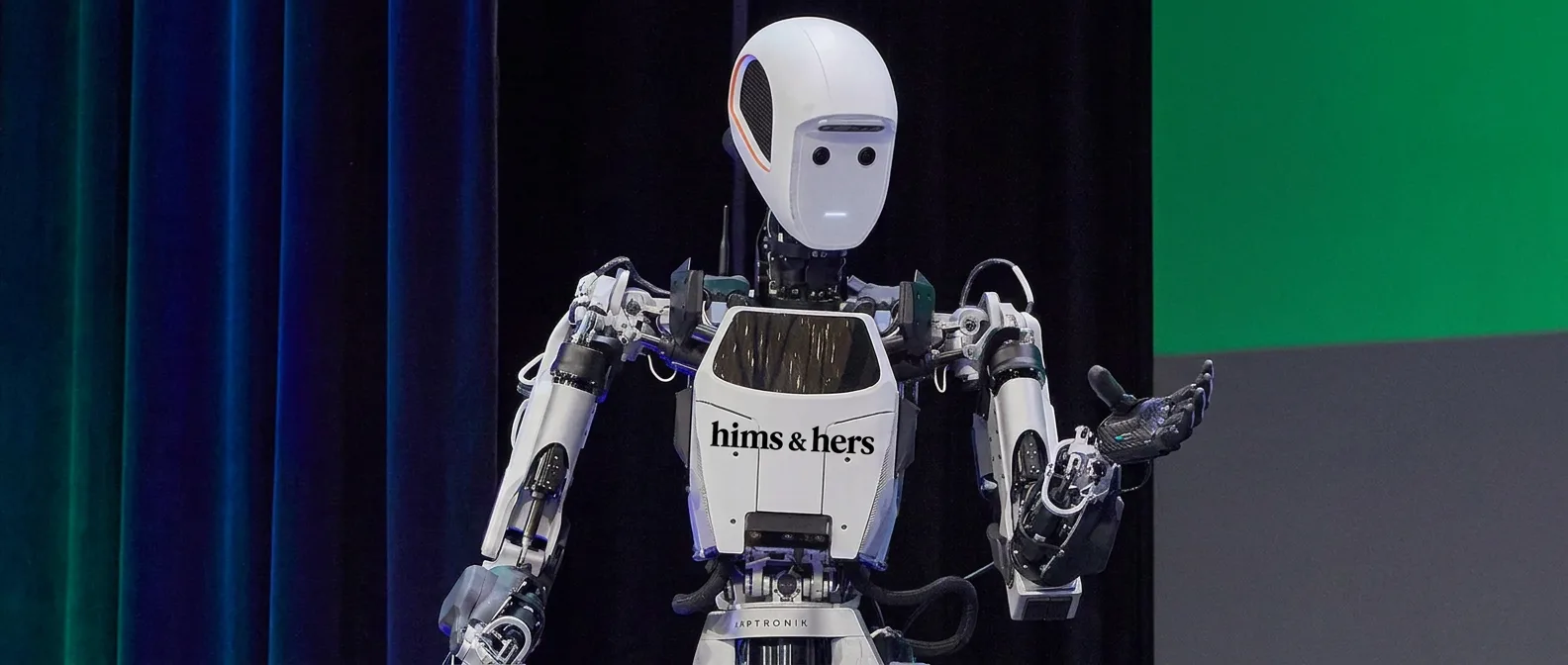
Hims & Hers has spent 2026 rebuilding much of its consumer-health platform around artificial intelligence, but in this next stage the company would take that strategy beyond smartphones and into the physical world with a new humanoid robot called HERO. The robot would be designed as a general-purpose personal assistant focused primarily on health, wellness and everyday household support, with Hims & Hers planning to sell the machine directly to consumers rather than limiting it to hospitals, pharmacies or research laboratories. HERO would stand roughly 1.5 meters tall, move on two legs, use two articulated arms and interact with users through voice, cameras, touch sensors and a simple front-facing display. The central idea would be to give Hims & Hers’ increasingly AI-native care platform a physical presence inside the home, allowing users to interact with the same broader health ecosystem through a robot capable of moving, carrying objects and responding to the surrounding environment.
The announcement would build naturally on the company’s real strategy. Hims & Hers launched Labs AI in May 2026 to help users understand laboratory results and biomarker trends, then expanded its broader doctor-led AI-native care model later in the year. The company has emphasized that its AI is intended to support customers and clinicians rather than replace licensed providers, with AI increasingly handling non-clinical tasks while doctors remain responsible for actual medical care. Hims & Hers has also committed to expanding its AI investment, including a new R&D lab in Menlo Park, as it attempts to make personalized healthcare more continuous and less dependent on occasional appointments. HERO would take that same philosophy and apply it to robotics: the machine could organize, remind, observe and assist, but it would not independently practice medicine.
HERO’s most visible function would be as a daily health companion. A user could ask the robot to remind them when it is time to take a prescribed medication, bring a sealed medication package from another room, display upcoming appointments or help them prepare questions before a telehealth consultation. If a person had recently completed laboratory testing through a connected Hims & Hers service, HERO could display information already available inside the user’s account and explain non-diagnostic trends using the same underlying tools available through Labs AI. If the user asked a question requiring medical judgment, HERO would be designed to stop at that boundary and offer to connect them with a licensed provider rather than invent an answer.
The robot would also help with broader wellness routines. HERO could remind users to drink water, stand up after long periods of inactivity, prepare for sleep at a consistent time or follow an exercise schedule. Users could ask the robot to bring resistance bands, carry a water bottle, move lightweight household items or guide them through simple stretching routines shown on its display. The goal would be to make health routines less dependent on remembering to open an app and more integrated into the environment around the user.
That physical presence would be the major difference between HERO and a conventional health app. A smartphone can send a reminder, but it cannot walk into another room and bring an item back. It cannot notice that a user has dropped something on the floor or help carry a light object when someone has limited mobility. HERO would be designed around this gap between digital intelligence and physical assistance, using AI to understand instructions while its robotic body handles basic tasks.
The machine would deliberately avoid the extremely strong motors used in some industrial humanoids. Because HERO is intended for homes, safety would be prioritized over lifting power. Its arms would be limited to relatively light objects, and joints would automatically reduce force when operating close to people. Cameras and depth sensors around the head and chest would continuously monitor nearby movement, while pressure sensors in the hands would detect when an object was slipping or when the robot encountered unexpected resistance.
If a child, pet or adult suddenly moved in front of HERO, the machine would slow down or stop rather than attempt to continue its path. The development team would describe this philosophy as “home-first robotics,” meaning that the robot is designed around unpredictable human environments from the beginning rather than adapting industrial hardware afterward.
HERO would also feature a simple face rather than an attempt at photorealistic human appearance. A dark display on the head would show eyes, status icons and basic expressions depending on what the robot was doing. When waiting for instructions, the interface might show a neutral expression. During charging, the display could dim and show a sleeping animation. When it needed human confirmation before performing a task, the screen would clearly display a request rather than allowing the robot to act silently.
Hims & Hers could use the design to make HERO feel more like a consumer product than a medical machine. The exterior would use white, soft gray and muted skin-safe materials rather than exposed metal, with optional fabric covers for parts of the body. Buyers could choose different visual themes and voices through the Hims app, while the underlying safety and health functions would remain identical.
The name HERO would be intentionally simple. It would not stand for an elaborate technical acronym at launch, but Hims & Hers would position it around the idea of a machine that helps people take small actions every day rather than performing spectacular medical procedures. The robot would not operate like an emergency-room doctor. It would be more likely to remind someone of an appointment, notice that a household item has fallen, fetch a bottle of water or help prepare for a provider call.
This distinction would become especially important in Hims & Hers’ marketing. The company has repeatedly emphasized that its AI-native care remains doctor-led, and that actual clinical decisions should stay connected to healthcare professionals. HERO would therefore be presented as an extension of the care experience, not an autonomous clinician. It could explain information already available in the user’s account, but it could not write prescriptions. It could remind someone about a medication schedule already established by a provider, but it could not independently change the dose. It could recognize that a user is asking about a potentially urgent symptom, but its role would be to escalate toward appropriate human care rather than diagnose the condition itself.
One of HERO’s most important features would be Care Mode, which users could activate when recovering from an illness, procedure or particularly difficult period. In Care Mode, the robot could increase reminders, keep commonly needed items within reach and check whether the user wants help contacting a provider. For older adults living independently, HERO could also provide simple safety functions such as detecting a possible fall or an unusually long period without movement and asking whether assistance is needed.
Those features would inevitably raise privacy concerns. A humanoid robot operating inside a home would have access to cameras, microphones and sensitive personal health information, creating risks far beyond those of a normal household appliance. Hims & Hers has made privacy and clinician-led care central themes in its public communication, and a HERO launch would likely emphasize on-device processing whenever possible, clear camera indicators and granular controls over what information is stored. Users could disable cameras in particular rooms, prevent video storage entirely or restrict which household members can access health features.
The robot would also need strong separation between household assistance and health information. A guest asking HERO to bring a drink should not gain access to the owner’s medical history. Sensitive information would require account authentication, voice recognition or confirmation through a connected phone. Hims & Hers could implement different household profiles, allowing the same robot to assist several family members while keeping each person’s private care information separate.
HERO could become especially useful for Hims & Hers customers because it would connect directly with the company’s broader platform. By the third quarter of 2026, Hims & Hers reported nearly 2.8 million subscribers and approximately $890 million in quarterly revenue, reflecting how far the company has expanded beyond its original categories. A physical product could theoretically strengthen that relationship by making the company present in customers’ homes throughout the day rather than only during occasional app sessions.
That strategy could also create a new subscription model. Buyers might purchase HERO hardware separately while paying for optional software tiers that include advanced AI features, additional household automation, personalized wellness programs or deeper integration with the Hims & Hers care platform. The base robot could continue functioning as a household assistant without a medical subscription, while connected health features would remain available only through eligible services and regions.
The company would also need to decide whether HERO should be open to third-party developers. Allowing developers to create skills for the robot could dramatically expand its usefulness, but health and safety restrictions would make a completely open platform difficult. Hims & Hers could instead create a tightly reviewed marketplace where approved developers build non-medical functions such as smart-home controls, entertainment, language learning or productivity tools.
The company would likely prohibit third-party software from directly controlling medication decisions or interpreting private health data without explicit permission. This would make HERO more restrictive than many general-purpose robots, but the limits would reflect the unusually sensitive environment in which the product operates.
HERO’s physical capabilities would improve gradually through software updates. Early models might be limited to carrying lightweight objects, opening compatible doors, organizing simple household items and interacting with smart-home devices. Later generations could gain better dexterity, allowing them to fold simple clothing, load objects into storage areas or prepare a workstation before a user begins work.
Hims & Hers could also use anonymized and permissioned interaction data to improve how HERO handles household tasks, although the company would face substantial scrutiny over exactly what data is collected and how it is used. The safest design would likely keep most raw household video local while transmitting only abstracted performance information needed to improve the robot.
Pricing would be one of the biggest barriers to mainstream adoption. A humanoid robot with sophisticated motors, batteries, cameras and AI hardware would initially be far more expensive than a smartwatch or smart speaker. In this scenario, Hims & Hers would target an introductory price in the premium consumer-electronics range, potentially offering monthly financing or subscription bundles to make HERO more accessible.
The company could also initially release a limited HERO Early Access program, allowing selected customers, researchers and care professionals to test the robot before wider commercial availability. Feedback from those households would be used to improve navigation, safety and reliability before mass production.
The biggest challenge, however, would be convincing people that they actually need a humanoid rather than another app. Hims & Hers would argue that physical AI changes the value proposition. Health routines often fail not because people lack information but because the actions themselves are inconvenient or easy to forget. A robot capable of physically helping with those routines could reduce some of that friction.