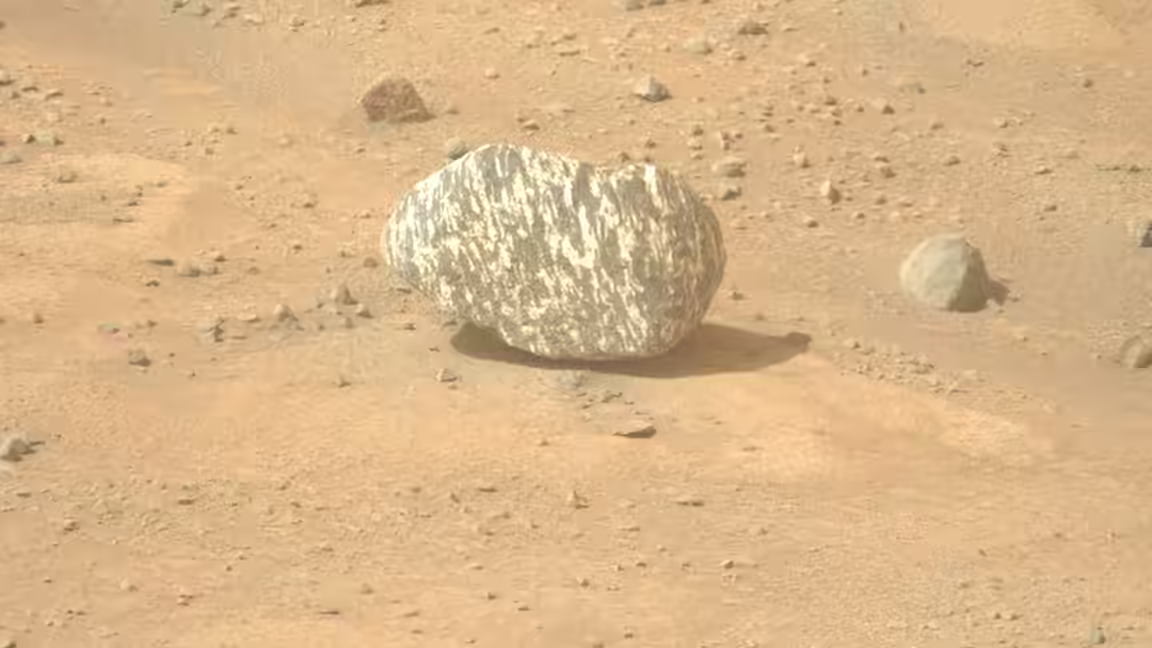
NASA's Perseverance rover has set a record for the greatest distance driven on another celestial body, reaching 45.22 kilometres, or 28.10 miles, on Mars. The milestone was recorded on mission sol 2006, corresponding to October 11, 2026, according to an update from Vandi Verma, chief engineer for robotic operations at NASA's Jet Propulsion Laboratory.
The record arrived later than a simple distance calculation might have suggested. Two months earlier, on sol 1947, Perseverance was roughly 200 metres short of the mark — a span its autonomous navigation system could cover in one drive. The science team instead kept the rover in an area of ancient rock outcrops, where it made short movements to abrade rocks and conduct close-range observations. It passed the previous record only after those investigations ended and the rover resumed its route.
The accumulated distance also reflects changes to how the mission operates the vehicle. Perseverance has crossed boulder fields, steep slopes and exposed bedrock, prompting engineers to test and revise its driving limits. After thousands of simulations, the team increased the permitted tilt to 24 degrees and reduced the required clearance beneath the rover's belly pan to 20 centimetres.
Engineers also modified braking software to avoid rocks, nearly doubled the current limits for steering motors and added dynamic slip tables to the flight software. Cross-slope driving has helped the wheels maintain purchase on bedrock. These are operational adjustments designed to let Perseverance navigate more challenging ground while protecting a rover that cannot be serviced in person.
A newer capability, onboard Global Localization, gives the rover another measure of independence. The system uses the commercial processor in the Ingenuity helicopter base station to compare surface and orbital images, then estimate Perseverance's global position after a drive. That serves a function similar to GPS on a planet without a positioning satellite network and can support longer drives with less human intervention.
Because that processor is not radiation-hardened like the rover's main flight computer, engineers developed software protections against transient memory errors caused by Mars' radiation environment. NASA says the team is also exploring generative AI to propose ways of steering autonomous navigation along segments of a planned path, an investigation rather than a declared operational replacement for human planning.
Perseverance is continuing upward along the rim of Jezero Crater. Its record is therefore both a numerical milestone and a measure of the operational techniques built over more than 45 kilometres of Martian driving.