Dragon's planned end reshapes NASA's options
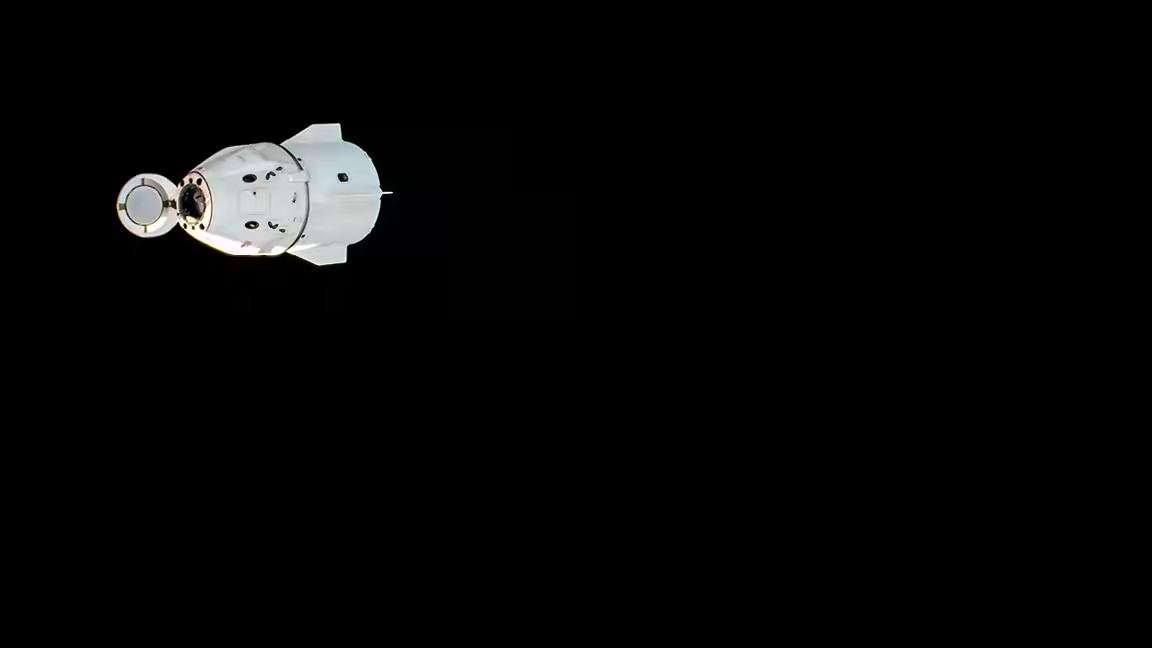
NASA is confronting a narrowing set of choices for carrying astronauts to low Earth orbit after SpaceX indicated that it plans to retire Crew Dragon and Falcon 9 missions once its International Space Station commitments end in 2030. Industry sources cited by Ars Technica said SpaceX has also told proposed private-station operators, including Axiom Space, Voyager Space and Vast Space, that they cannot order Dragon crew flights for their future habitats.
The shift matters because Dragon has become NASA's operational US crew vehicle. NASA invested about $3.1 billion in its development and certification through the Commercial Crew Program. SpaceX was originally obligated to perform six missions but has already flown 13 for NASA, with another due soon, and has agreed to continue through Crew-17. Those completed and contracted flights mean the agency has little contractual leverage to force the company to extend the system indefinitely.
NASA Administrator Jared Isaacman publicly acknowledged that SpaceX wants to phase out its older platforms while concentrating on Starship. Yet SpaceX has reportedly shown no interest in developing Starship for crew launches from Earth into low orbit at present. Certifying that much larger vehicle for astronaut ascent and re-entry would introduce additional safety and regulatory work, while NASA's immediate Starship effort is focused on a lunar-landing version for Artemis.
Starliner becomes more important
Boeing's Starliner was intended to provide the second leg of NASA's commercial crew strategy, but it has not yet completed an operational station mission despite roughly $5.1 billion in agency investment. NASA now plans another $359 million of support for propulsion fixes and certification of United Launch Alliance's Vulcan rocket for future missions. The goal is to use Starliner during the remaining ISS era and potentially make it available to commercial station operators later.
That course carries cost and competition risks. Ars reported a current NASA seat price of about $90 million for Starliner during the ISS period, compared with roughly $78.8 million for recent Dragon missions and about $55 million for early Dragon seats. With Dragon absent, there is no clear reason for prices to fall.
A fresh commercial-crew competition could invite Blue Origin, Sierra Space or another provider, but developing and certifying an additional system would likely cost billions and compete with NASA's lunar priorities. Continuing with Boeing uses an investment already made, while leaving the agency more dependent on a vehicle with a difficult development record.
The problem extends beyond NASA. A sustainable private-station market needs predictable transport for crews and customers. If Starliner becomes the principal Western vehicle after 2030, its schedule, price and reliability will influence whether planned stations can attract institutions, governments and private astronauts. NASA's original two-provider model reduced dependence on any single company; SpaceX's change in direction threatens to reverse that outcome just as the ISS era approaches its end.