Developer Alexey Fateev has released an experimental operating environment that runs the Qwen3-0.6B language model directly on x86-64 hardware without Linux, Windows or a conventional runtime library. The bootable program itself is 24,252 bytes and is written in assembly language.
The project, published under Fateev's alesha-pro GitHub identity, starts in 64-bit mode, initializes multiple processor cores and maps the quantized model weights from physical memory. Users interact through a text interface supporting VGA output, a PS/2 keyboard and a serial connection. The operating code is tiny, but the Q8_0 model data remains much larger: the tested weights occupy roughly 614 MiB to 649 MB, depending on the measurement convention used.
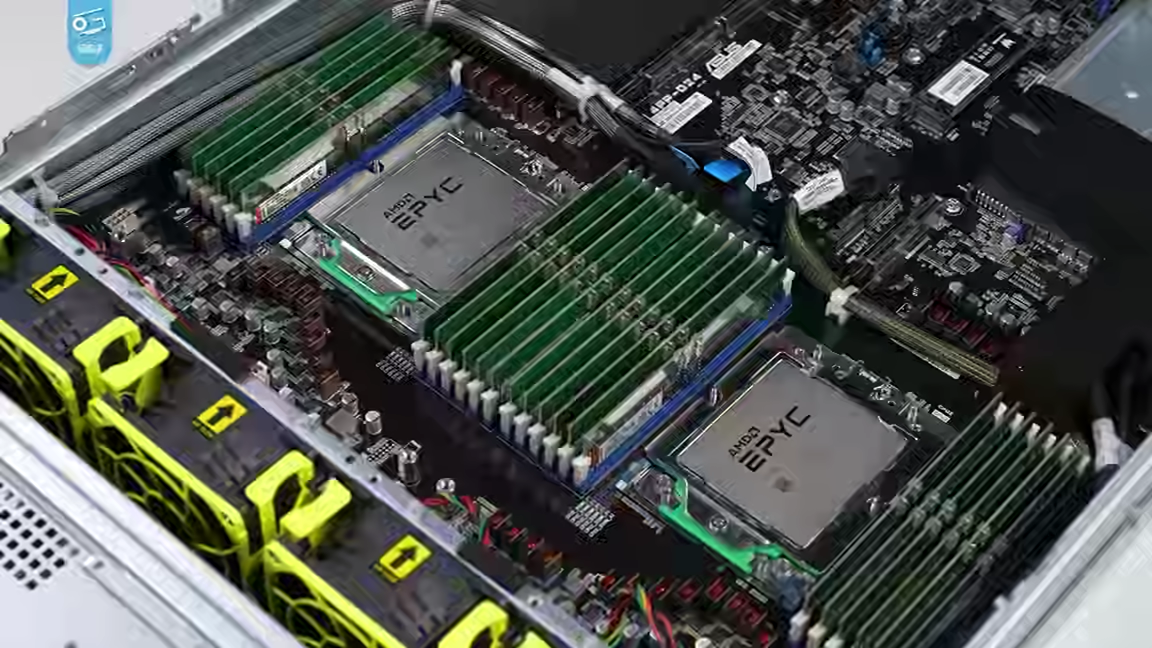
Fateev reported a boot time of 74 to 94 milliseconds for the core environment. On an AMD EPYC 7642, developer-run comparisons against llama.cpp using CPU-only Q8_0 inference showed improvements at each listed thread count. The four-thread run reached 78.89 tokens per second, compared with 51.08 for llama.cpp, a reported 54% advantage. Gains at one, eight and 16 threads ranged from 31% to 46%.
Those numbers should be read as project benchmarks rather than independent performance certification. A hand-built environment dedicated to one model removes services and abstraction layers that a general-purpose operating system supplies. It also gives up the hardware compatibility, security facilities, process isolation and software ecosystem expected from Linux. The experiment demonstrates what can be achieved under tightly controlled conditions, not a drop-in replacement for a production inference server.
The project also includes a Linux-hosted assembly inference binary of about 14.7KB. According to the published results, that version surpassed llama.cpp by 18% to 36% across tests using one to 40 threads. Fateev said output remained consistent across thread counts and matched a 64-token greedy reference generated with PyTorch FP32.
A diskless virtual-machine test on an older 12-core Intel Xeon system booted to an interactive prompt in under five seconds and ran from memory. The repository provides source code, an ISO builder and setup material for Proxmox, making the work available for inspection and reproduction.
The release is a specialized systems experiment at the intersection of model inference and bare-metal programming. Its practical value will depend on whether other testers can reproduce the reported speed gains and adapt the narrowly targeted code to different processors and model configurations. Because the environment is intentionally minimal, future evaluations will also need to separate gains from assembly-level optimization, huge-page use and the absence of operating-system services. Comparisons on additional CPUs and longer inference workloads would show whether the measured advantage persists beyond the published setup.