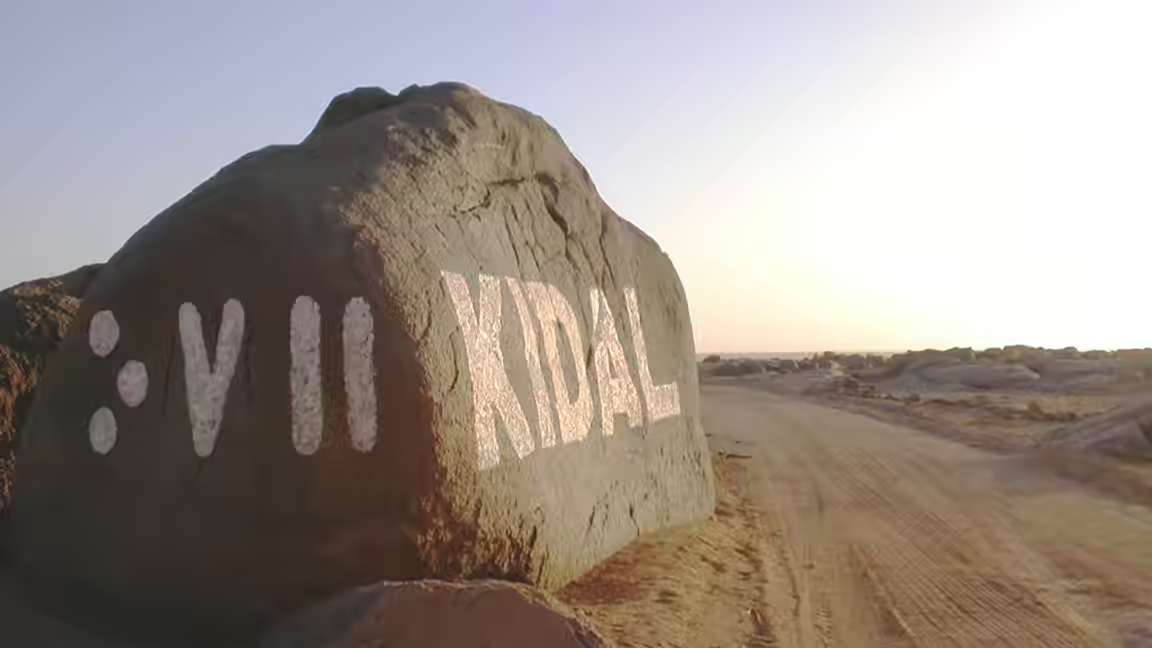
Mali’s armed forces entered Kidal with support from Russia’s Africa Corps, restoring government control of the strategic northern city five months after Tuareg separatists captured it.
The Malian transitional government said on state television that its troops had consolidated their positions on the event date of October 7, 2026. It attributed the advance to intensive operations conducted on the ground and from the air with Russian support.
The Azawad Liberation Front, or FLA, offered a different account of how control changed. The separatist movement said it executed a controlled withdrawal and that government troops entered without a battle. It described the move as temporary and said it was intended to protect lives in the face of what it called disproportionate Russian air power.
Both accounts agree on the immediate result: Malian forces are back in Kidal. They differ over whether the development represents a military recapture or a tactical separatist departure. No independent battlefield assessment was included in the supplied evidence, so the competing characterizations cannot be resolved here.
Kidal has long carried political and military importance as a center of Tuareg influence in northern Mali. Separatists seized the city in April during coordinated attacks across the country involving the FLA and Jama’at Nusrat al-Islam wal-Muslimin, the regional affiliate of al-Qaeda. Those attacks also killed Mali’s defense minister and intensified pressure on the military authorities that took power in coups in 2020 and 2021.
The latest shift follows years of changing control. Malian troops and Wagner personnel retook Kidal in November 2023, but the government lost it again in April 2026. Russia’s Africa Corps replaced Wagner in Mali in June 2025 and operates under the Russian Defense Ministry, according to the reporting supplied for this article.
Mali’s military government has increasingly relied on Russia after moving away from Western security partners. Re-establishing a presence in Kidal therefore offers both Bamako and Africa Corps a visible success after recent setbacks.
Its wider military effect remains uncertain. Security analyst Beverly Ochieng of Control Risks assessed the return as a boost to the army’s morale and the government’s authority, while cautioning that it was largely symbolic rather than decisive in the broader conflict.
Mali’s security crisis dates to 2012 and involves separatist forces as well as armed groups aligned with al-Qaeda and the Islamic State organization. Control of one city does not end those overlapping conflicts, but Kidal’s prominence ensures that the latest change will be closely watched.